

A deal desk process is the operating model a B2B technology revenue team uses when a deal leaves standard terms. It names the decision, the evidence required, the owner, and the handoff back to the seller. Without that model, a discount, a nonstandard payment term, or a legal exception sits in someone's inbox while the buyer waits. The seller then invents a path. Finance hears the request late. Legal sees a redline with no commercial context. Leadership is asked to bless a number it cannot inspect.
That split is not a buyer problem. The buyer's path to signature is a separate question, and this article does not try to answer it. The deal desk process is the seller's internal path for exceptions that standard quoting cannot clear on its own.
What is a deal desk process?
A deal desk process is a written set of rules for commercial exceptions. It covers four questions:
- Which deals stay on the standard path, and which ones enter the desk.
- Which decision each function owns: price, margin, terms, risk, or executive exception.
- What evidence must be in the packet before anyone is asked to decide.
- How the decision gets back to the seller, with a date and a next step the buyer can hear.
It is not a weekly deal review, and it is not a software category. A weekly review inspects whether the opportunity is real. A deal desk decides whether the company will accept a specific exception. Software can route the packet. It cannot decide who is allowed to say yes.
PwC's Technology Institute described the same split in its 2014 deals desk note. No-touch quotes already meet a published policy and should clear on their own. Low-touch quotes need a light check against that policy. High-touch deals need a named person because the exception is no longer routine.
The useful test is not whether you have a deal desk. The test is whether a seller can predict the path before promising the buyer a date.
RevCentric treats this operating model as sales process support, not as a side committee that meets when a deal is already late. Proven sales operators sit in live calls and live reviews so the packet matches how the team actually sells. A desk that exists only in a slide will be bypassed the first time a quarter-end deal is late.
Which deals should enter the desk?
Most technology quotes should never see the desk. If the configuration, discount, and terms sit inside a published band, the quote should clear without a meeting. Send a deal to the desk only when one of these is true:
- Discount, payment terms, or giveaways sit outside the band the seller is allowed to offer.
- The configuration is nonstandard: multi-product, usage-based, services-heavy, or a commitment the standard quote cannot describe.
- Legal, security, or liability language departs from the paper the company will sign without review.
- The deal is large enough, or strategic enough, that a wrong yes changes margin or precedent for the next ten deals.
Write the entry rule as a threshold a seller can apply without asking. "Anything weird" is not a rule.
A usable rule names the breach. More than the published discount is a breach. Any nonstandard liability is a breach. Services scope over the standard statement of work is a breach.
Keep the buyer's paperwork on its own track. Mapping procurement, legal, and security on the customer side is the paper process, covered in how to document the MEDDPICC paper process. The desk uses that map as an input. It does not replace it. A seller who knows the buyer's paper path still needs an internal owner for the exception the buyer just requested.
Who decides, and what do they decide?
A deal desk fails when every function is invited to every decision. Give each seat one decision, and keep the others out of that seat.
Use the table below as the assignment. Each row is one owner, one decision, and one handoff.
| Seat. | Decision they own. | Evidence they need. | What they hand back. |
|---|---|---|---|
| Seller and frontline manager. | Whether the exception is real, and whether the deal still qualifies. | The buyer ask, in the buyer's words, plus the MEDDIC or MEDDPICC gaps that the exception does not fix. | A complete packet, or a decision not to submit. |
| Deal desk or revenue operations. | Whether the packet is complete and which path it takes. | The threshold breached, the quote version, and the date the buyer needs an answer. | A routed request with a response date. |
| Finance or pricing. | Whether the price and terms protect margin and precedent. | List price, requested price, giveaways, services cost, and the comparable deals already approved. | Yes, yes with a cap, or no, in writing. |
| Legal. | Whether nonstandard language is acceptable risk. | The clause, the commercial reason, and what the seller will give up if legal says no. | Approved language or a specific refusal. |
| Sales leadership. | The rare exception that breaks a written rule. | Why the rule should bend on this deal, and what precedent it sets. | A named exception, not a vague approval. |
Heads of Sales own the qualification call. Heads of Revenue Operations own the path and the clock. Heads of Enablement own whether sellers can build the packet without a hallway conversation. If leadership is in every discount, the band is wrong. Fix the band. Do not add another meeting.
Harvard Business Review made the broader point in "The New Science of Sales Force Productivity" (Ledingham, Kovac, and Locke Simon, September 2006): handing each seller a patch and wishing them luck does not scale. A desk is one place that idea becomes a rule someone can follow on Thursday afternoon.
What belongs in the evidence packet?
Do not ask finance to "take a look" at a Slack thread. The packet is short on purpose. If it takes more than a page, the seller does not yet know the ask.
- State the buyer ask. Include the exact concession, in the buyer's words, and the date they need an answer.
- Show the commercial math. Include list price, requested price, payment terms, services, and anything else that changes margin. Label the math as this deal's math. Do not present it as a benchmark for other deals.
- Attach the qualification evidence. Include metrics, economic buyer, decision criteria, decision process, paper process, and the champion's proof. An exception does not repair a deal that fails the MEDDIC decision process.
- Cite the precedent. Name the last two or three similar yeses or nos, so this answer does not invent a new policy by accident.
- Name the walk-away. Say what the seller will do if the answer is no. A packet with no walk-away is only a request for permission to discount.
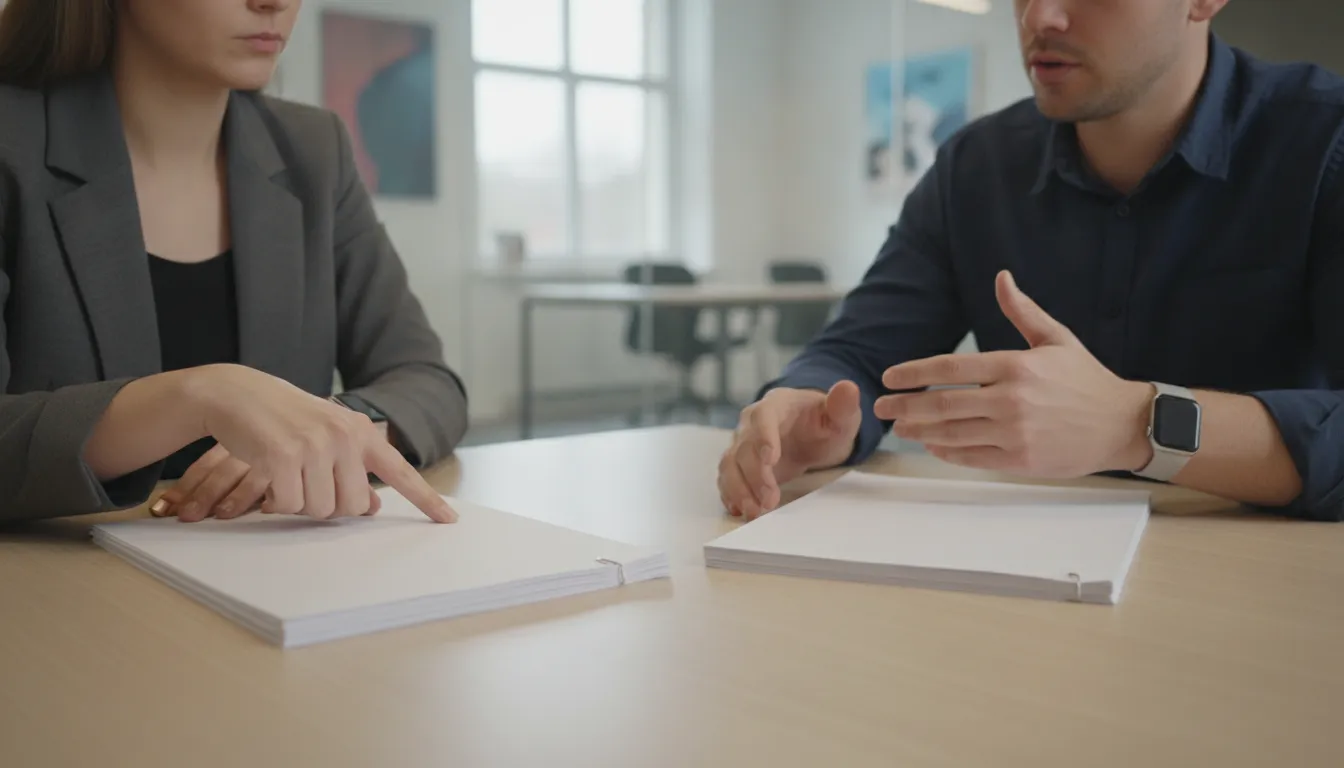
Managers already inspect deal quality in a different forum. Keep that forum. A weekly MEDDPICC deal review should expose risk before the seller asks the desk for a concession. The desk is the wrong place to discover that nobody has met the economic buyer.
How should the handoff work?
Write the handoff as a clock, not a culture value. A practical version for a technology company looks like this.
- Submit the packet. The seller files it only after the manager has confirmed the deal still qualifies. Incomplete packets go back the same day, with the missing line named.
- Route the question. Revenue operations sends price questions to finance and language questions to legal. It does not copy both functions on every request.
- Decide inside the window. Each owner answers inside a published window. Two business days is a workable window for a high-touch exception. Same day is realistic only when the request is a single number inside a known band. Publish the window you will actually keep.
- Return a usable answer. The seller gets a yes, a capped yes, or a no. Plus the sentence they are allowed to say to the buyer. "We're still looking at it" is not a return.
- Record the precedent. The decision, the reason, and the precedent land on the opportunity. The next seller should not have to reconstruct it from memory. Teams that already keep qualification in the CRM can attach the decision next to those fields, the same way they integrate MEDDPICC into the CRM.
Teach the handoff in the trench, not in a kickoff slide. A seller should build one live packet on a real opportunity, with a manager beside them, before they are asked to do it alone. That is Sellers Teaching Sellers applied to commercial exceptions: the operator who has carried a deal shows the next person what "complete" looks like.
Stage design stays a separate job. If the underlying stages do not say what evidence a deal must show, the desk becomes a rescue service. Build that evidence standard in the B2B sales process around buyer value, then let the desk handle only the exceptions.
How do you know the desk is working?
Judge the desk by behavior you can see, not by a slogan about speed. Four checks are enough:
- Path predictability. Before a seller submits, they can name which seat will answer and the date that answer is due.
- Complete packets. The share of packets returned for a missing line should fall after the first month. If it does not, the template is too vague or the coaching never happened on a live deal.
- Decision hygiene. Exceptions outside the band have a named approver on the opportunity. Side-channel yeses stay visible, and they stay rare.
- Precedent control. Similar deals receive similar answers. When they do not, the opportunity record states the reason in a sentence another seller can read.
Cycle time and margin movement are worth watching, but only as this company's numbers. Do not borrow another firm's percentage and call it your forecast. PwC reported cycle-time and productivity ranges from its own client work in 2014. Those ranges are not a promise for your pipeline.
If sellers still route exceptions through a private message to a friendly executive, the desk is theater. Fix the entry rule, the packet, or the clock. Adding another stakeholder will make it slower.
What should each leader do this month?
Do not launch a desk by naming a committee. Give each leader one job they can finish before the next forecast call.
The Head of Sales picks the three exception types that caused the last slipped deals, then writes the band a seller may offer without help. Anything inside that band never enters the desk. The same leader confirms that managers will refuse an incomplete packet instead of forwarding it.
The Head of Revenue Operations publishes the path and the clock. That publication names which seat sees price, which seat sees language, and the response window the company will keep. The decision goes on the opportunity so the next review does not depend on a private thread.
The Head of Enablement teaches the packet on a live deal, not in a classroom. They sit with one seller, build the one-page ask, and have the seller say the return sentence out loud. They repeat that coaching on the next two exceptions. That is Teaching in the Trenches: the operator who has carried the deal shows what a complete packet looks like.
Stop once those three jobs are done. A desk with a band, a clock, and a packet sellers can build is more useful than a desk with a charter and no recorded decisions.
Which failure should you fix first?
Teams usually have one broken piece, not five. Match the symptom before you redesign the whole path.
- Sellers cannot say who decides. The entry rule is missing, so write the band and the seats before you add another meeting.
- Packets come back missing the ask or the math. The template is too long, or nobody has practiced it on a real opportunity. Cut the packet to one page and coach the next submission live.
- Answers miss the buyer's date. The clock is unpublished, or every function is copied on every request. Route price questions to finance and language questions to legal.
- Similar deals get different yeses. Precedent is not on the opportunity. Attach the decision and the reason before you approve the next exception.
- The desk is asked to save an unqualified deal. That request belongs in a deal review, not at the desk. Send it back to the manager, because an exception cannot invent an economic buyer.
Fix the first matching symptom. Then run five real exceptions through the path and read what came back. If the seller can predict the owner, the date, and the sentence they may tell the buyer, the deal desk process is doing its job.
Glossary
- Deal desk process: The rules for who decides a commercial exception, on what evidence, and how the answer returns to the seller.
- No-touch quote: A quote inside published bands that clears without a person.
- High-touch deal: A nonstandard or high-value opportunity that needs a named owner in sales, finance, legal, or leadership.
- Evidence packet: The one-page ask, math, qualification proof, precedent, and walk-away.
- Paper process: The buyer's path from verbal commit to signature. Related, but not the desk.
Frequently Asked Questions
What is a deal desk process in a sentence?
It is the written path a revenue team uses when a deal needs a commercial exception: who decides. What evidence they need, and how the answer gets back to the seller.
Is a deal desk the same as a deal review?
No. A deal review inspects whether the opportunity is qualified. A deal desk decides a specific exception, such as price, terms, or nonstandard language.
Which deals should skip the desk?
Quotes that sit inside the published discount, configuration, and terms should clear without a meeting. Send only the breaches.
Who should own the deal desk?
Revenue operations should own the path and the clock. Finance owns price and margin. Legal owns nonstandard language. Sales leadership owns the rare break of a written rule. The seller owns a complete packet.
How is this different from the buyer's paper process?
The paper process is how the buyer gets to a signature. The deal desk is how your company approves the exception the buyer requested. You need both, and they should not be the same meeting.