

Value based messaging technical buyers will accept is one claim they can test, not a shorter executive pitch. Take a security-platform evaluation. The architect has to prove that access reviews move off a spreadsheet and into the buyer's identity provider. The buying committee then has to defend that same claim in the business case. When those two jobs use different stories, the deal stalls or the purchase is regretted later.
Gartner's Tech Buying Behavior Primer for 2024 reports the cost of a story nobody can test. In its 2022 Functional Business Buyers survey, 81 percent of respondents felt moderate or high purchase regret after buying software for their function. Only 17 percent reported a high-quality deal. Gartner ties better outcomes to early agreement on goals, and to confidence in both the decision approach and the path to value. A claim the technical buyer cannot test does not create that confidence.
What does value based messaging for technical buyers have to do?
A technical buyer can say whether the product will run, integrate, stay secure, and be supported. That person may be an architect, a security lead, or an IT director. They rarely own the budget. They do own the veto.
Value messaging for that reader has three jobs:
- Name the operating problem the capability changes, not the feature list.
- State the test that would prove or disprove the claim in this environment.
- Give the technical buyer one sentence the economic buyer can reuse.
The value messaging framework still starts with a buyer problem and ends with an outcome. For a technical buyer, the middle of that path is a test. "Reduces integration effort" is not a message until the team names the systems and the current effort. It also has to name the evidence that would change the architect's mind.
RevCentric builds this as one messaging construct the go-to-market team shares, then coaches it on live calls. The point is not a new slogan. It is a message sellers, sales engineers, and managers can inspect in an active deal.
Why does a feature story fail the technical buyer?
Stay with the access-review deal. The seller opens with a slide of connectors, certifications, and architecture boxes. The architect uses that slide to disqualify a weak fit. The architect does not use it to sponsor a purchase.
Three failures show up before the first working session:
- The claim has no owner. "Enterprise-grade security" does not say which control the security lead cares about, or what evidence would satisfy them.
- The proof is a demo, not a test. A scripted demo runs in the vendor's tenant. It does not show the buyer's identity provider, group model, or Friday change window.
- The technical win is stranded. The architect agrees the product can connect, then cannot tell finance why the spreadsheet review should stop. The deal dies in translation.
Gartner's primer also says buyers need confidence in the decision approach, not only in the product. A feature story that only the seller understands cannot give a buying group that confidence.
How do you build value based messaging technical buyers can share?
Start with one use case, not the product. In this deal the funded initiative is access review. Write four lines the account team must say the same way.
- Current obstacle. Managers export group membership to a spreadsheet, chase owners by email, and still miss stale access before the audit.
- Required capability. The review must run against the identity provider the company already uses, with admin rights separate from reviewer rights.
- Future state. The access owner finishes the review inside the change window, and the security lead can see who signed off.
- Business consequence. Audit prep stops consuming a full week of manager time, and open access does not sit until the next cycle. Doing nothing keeps both costs.
That last line is the bridge. The architect does not need a finance model in the working session. The architect does need a sentence to stand behind when the executive asks why this evaluation matters. Heads of Sales own whether sellers can say it. Heads of Enablement own the talk track and the proof. Heads of Revenue Operations own whether the opportunity record matches the call.
Add a second persona only when the test truly splits. The platform owner and the security reviewer can share the obstacle and the consequence while testing different controls. A separate value story for every title makes sellers improvise, and the committee hears contradictions.
What should value based messaging technical buyers be able to test?
Name the proof before the meeting. Agree on it with the buyer, write it down, and do not "circle back" on the criterion that decides the recommendation. On the access-review deal, the architect's test was specific: map three objects to the identity provider, with no custom service, inside the existing change window.
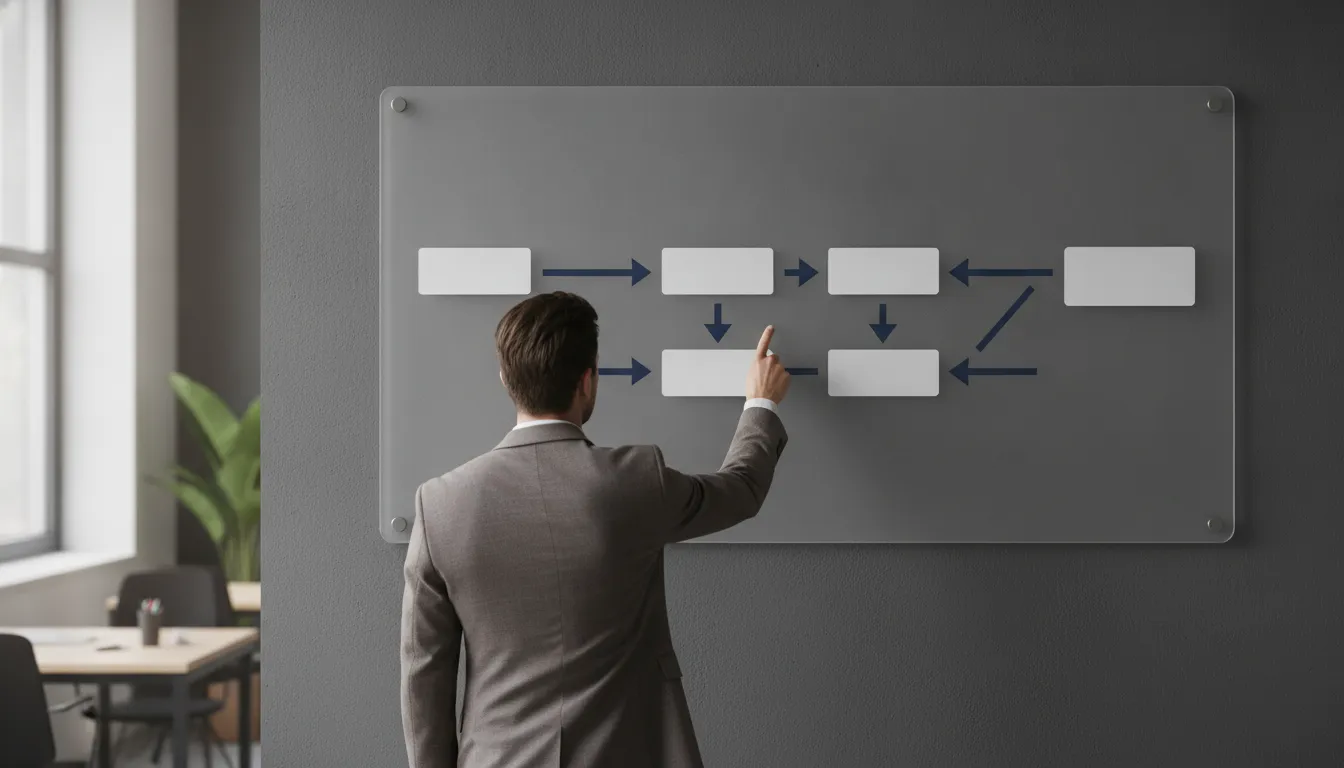
Read the board from left to right. The first card is the single claim. The next card is the test the technical buyer owns. The split is the second check, often security or operations, on that same claim. The last card is the one proof the committee can defend. If a box cannot be filled from this account, it does not belong on the board.
| What the buyer is judging | Weak message | Message the buyer can test | Proof in the evaluation |
|---|---|---|---|
| Integration | We have a native connector. | Your team maps these three objects with no custom service. | A working session on the buyer's schema, with the architect owning the gap list. |
| Security and access | We are enterprise ready. | Access follows your identity provider, and admin rights are separate. | A control-by-control review with the security lead, not a logo slide. |
| Scale | It scales. | This review stays inside the time you set at your group count. | A bounded test that uses the buyer's volume, written down before it runs. |
| Operability | Implementation is easy. | Your access owners run the first review with no new specialist role. | A day-in-the-life walkthrough with the people who would operate it. |
| Time to first value | Customers go live quickly. | The first review is usable inside the change window you already have. | A mutual plan with an owner, a date, and a definition of usable. |
Leave out any vendor benchmark the buyer did not supply. If the buyer did not set the volume, the control, or the definition of done, the number is decoration. MEDDIC decision criteria help because they force an owner, a reason, a weight, and an acceptable proof. Use them to design the test. Do not paste the framework into the message.
How should a proof of concept serve the message?
A proof of concept that tours the product fails the architect and tires the committee. A proof of concept that tests the message does both jobs. On this deal, the team wrote the pass rule before the tenant was opened: three objects mapped, admin rights separate, and a completed review the security lead could export.
Put the success criteria in the buyer's words:
- The one use case in scope, and the use cases explicitly out of scope.
- The technical pass-fail test from the table above.
- The business observation the sponsor expects if the test passes, such as a shorter review or a control the security lead accepts.
- Who attends the readout, including someone who was not in the build.
The sales engineer and the account executive should rehearse that readout together. The engineer confirms what was tested. The seller connects the result to the consequence the committee is weighing. If the test fails, say so. A technical buyer trusts a team that narrows scope more than a team that rewrites the result.
This is where live coaching matters. A classroom deck cannot show a seller what to do when the architect adds a system that was not in the plan. Practicing on the live evaluation, with a practitioner listening, is how the message survives contact with the account.
How do you translate the proof for the buying committee?
The committee does not want a second architecture review. It wants to know whether the people who understand the system will stand behind a decision. After the access-review test, the champion has to explain the result without the seller in the room.
Use a short readout with four blocks:
- What we tested. One use case, the environment, and the pass-fail rule.
- What passed, what did not, and what was not tested. Leaving this blank is how regret starts. The buyer later finds a dependency nobody scoped.
- What changes if the team proceeds. Tie this to a metric the economic buyer already tracks. The metrics used to quantify business value should come from the buyer's baseline, not from a sample calculator.
- What decision is being asked for now. A security review, a commercial step, or a stop. Match the ask to the real buying path, not to the seller's forecast stage.
The technical buyer should deliver the first two blocks without the seller. The champion delivers the third. The sponsor hears one story. If only the seller can explain the value, the message is not ready.
Executives still need their own conversation about risk, timing, and the cost of waiting. That meeting is covered in value messaging for executive buyers. Do not drag the architecture diagram into it, and do not drag the executive script back into the technical evaluation. Same claim, different proof.
How can revenue leaders tell the message is holding up?
Leaders do not need a messaging score. They need evidence from live deals. In pipeline review, the access-review opportunity should show the use case, the architect, and the three-object test in the notes. A generic deck in the field is a miss.
Inspect five things:
- The opportunity names one use case, not a product bundle.
- The technical buyer is a person, and the required test is in the notes.
- The proof asset matches that test.
- The business consequence uses the buyer's baseline. A pasted return-on-investment slide is a miss.
- The next step on the mutual action plan is a decision the committee can actually make.
Enablement should retire talk tracks that sellers cannot say with a sales engineer present. Revenue operations should make the use case, the technical owner, and the agreed test fields the manager looks at. Sales leadership should coach the readout, not only the first meeting.
When those three roles describe different value on the same deal, the buying committee will too. Fix that before adding another slide.
Which assets should a seller bring to the technical buyer?
The message fails in the room when the only asset is a master deck. The architect will ask to see the specific mapping or control. Bring a small kit for the one use case, and leave the rest out.
- A one-page claim. Obstacle, required capability, future state, and business consequence. No product tour.
- A test card. The pass-fail rule, the environment, the owner on the buying team, and the readout date.
- A proof worksheet. What passed, what failed, and what was not tested. The seller and the sales engineer fill it in before the committee meeting.
- A decision ask. The single next step that matches how this account approves a purchase.
Demo scripts and architecture slides stay in the kit only when they prove a line on the test card. If a seller cannot point to that line, the slide does not go into the meeting. Heads of Enablement should treat these four assets as the kit. Heads of Sales should refuse a forecast commit on a deal with a blank test card.
Coaching belongs on the call where the technical buyer challenges the test, not in a recap the following week. That is the "Teaching in the Trenches" standard: a proven operator listens to the live conversation and helps the seller adjust the claim while the buyer is still in the room.
Frequently Asked Questions
What is value based messaging for a technical buyer?
It is one claim about an operating problem, the capability that would change it, and the test the technical buyer will use to accept or reject it. The same claim has to be defensible to the rest of the buying committee.
How is this different from a feature message?
A feature message lists what the product can do. Value messaging for technical buyers states what will be different in the buyer's environment, how that difference will be proven, and what follows if the proof holds.
Should every persona get a separate value message?
No. Give the committee one use case, one obstacle, and one business consequence. Let security, architecture, and operations test different capabilities inside that use case. Separate stories create contradictions the economic buyer can hear.
What belongs in a proof of concept?
One use case, a pass-fail test the technical buyer accepted, an explicit list of what is out of scope, and a readout someone outside the build can understand. A tour of the product is not a proof of concept.
Who should own this inside the selling team?
Sales leadership owns whether the message shows up in deals. Enablement owns the talk track and the proof assets. Revenue operations owns the fields managers inspect. Sales engineering designs the test and rehearses the readout with the account owner.